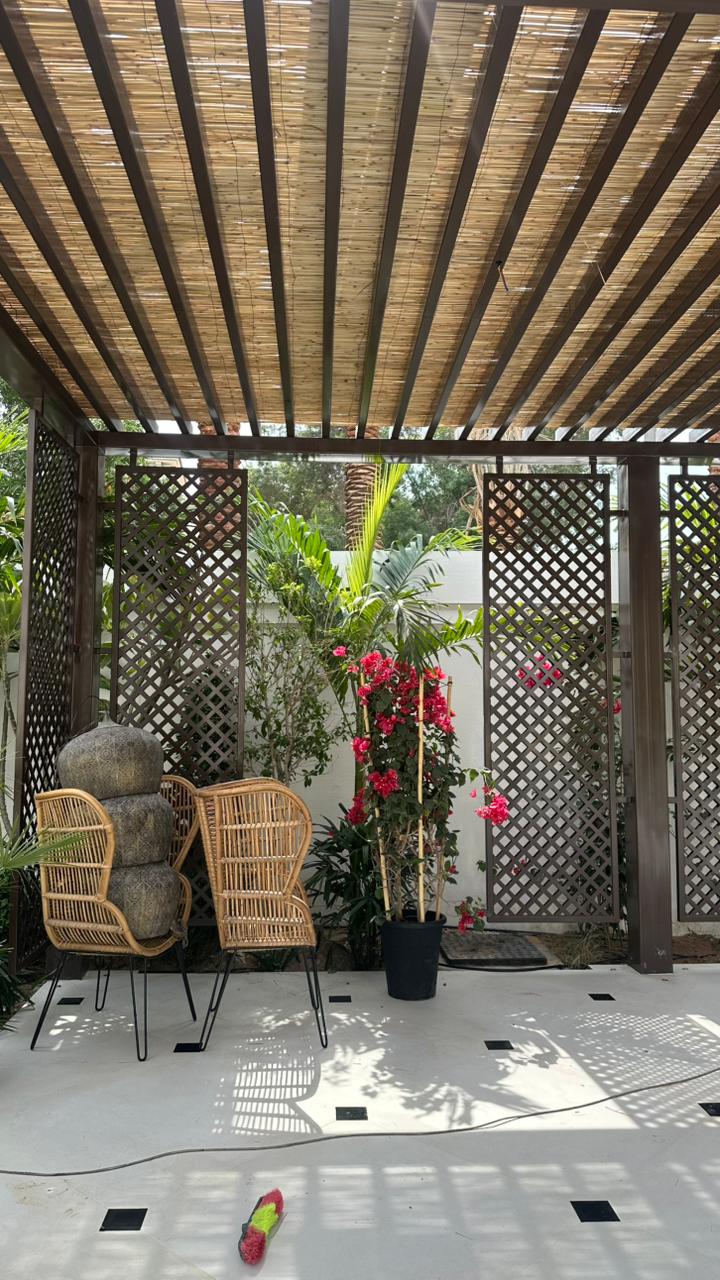
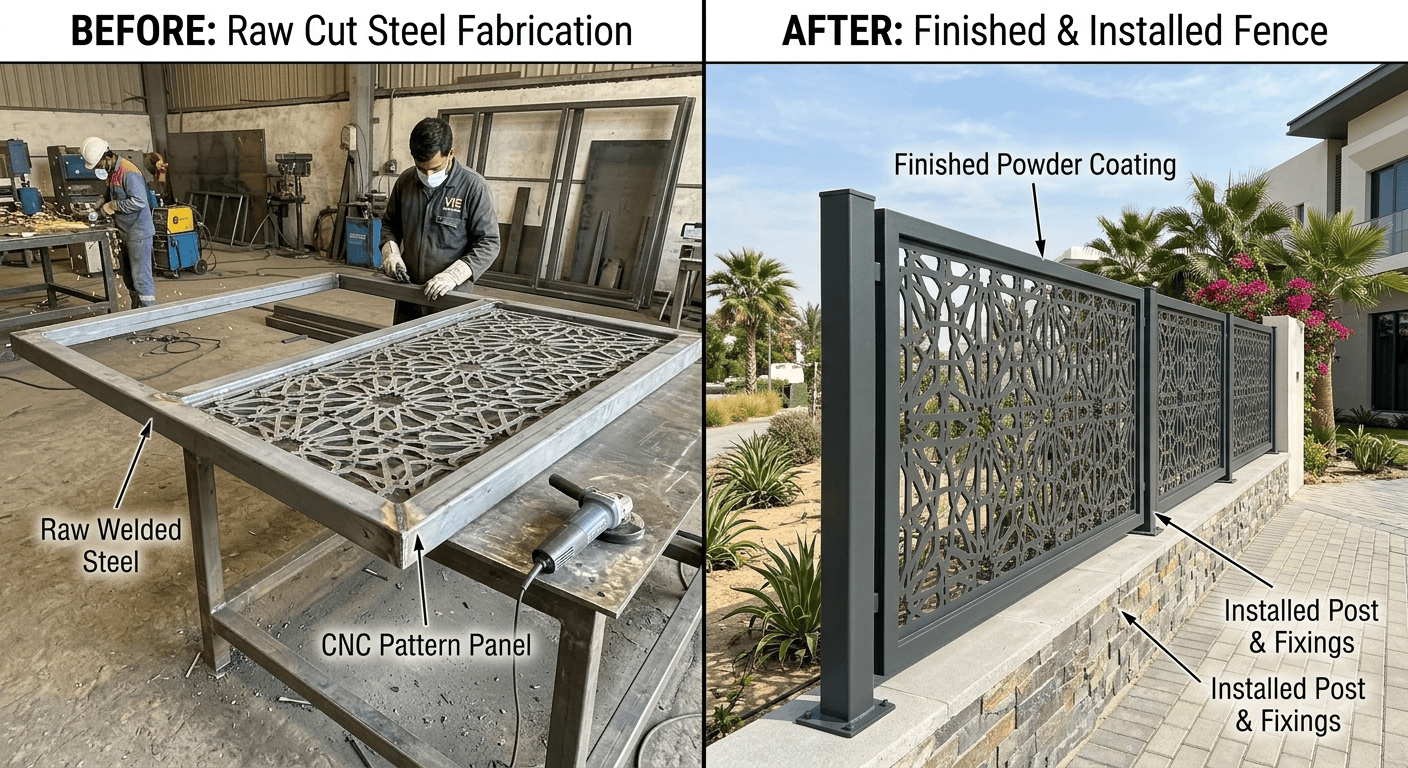
Custom gates and railings are usually the first thing a visitor notices about a UAE villa — before the front door, before the garden, before anything else. They’re also one of the few exterior elements that face UAE’s climate head-on every single day: direct sun, salt-laden coastal air, sand, and summer heat that can push metal surface temperatures past 50°C. Choosing the wrong material or the wrong fabricator shows up fast — usually as rust, sagging hinges, or fading paint within the first two summers.
This guide covers what UAE homeowners are actually choosing right now, the metal and non-metal materials available, the different types of gates and railings, and what to check before you hire anyone to build them..
What UAE Homeowners Are Choosing Right Now
Preferences are fairly consistent across Dubai, Abu Dhabi, Sharjah, Ajman, Ras Al Khaimah, Fujairah, and Umm Al Quwain, since villa communities across the country share similar climate pressures and, often, similar HOA design guidelines. A few trends stand out:


Metal and Non-Metal Materials Compared
The material decision affects cost, maintenance, and how the piece ages in UAE conditions more than the design does. Here’s how the common options stack up:.
| Material | Type | Best For | Maintenance | Relative Cost |
|---|---|---|---|---|
| Cast/extruded aluminum | Metal | Gates, laser-cut panels, balcony frames | Very low — doesn’t rust | Mid |
| Stainless steel (316 grade) | Metal | Coastal railings, premium gates, balustrade posts | Low — occasional cleaning | Mid-High |
| Stainless steel (304 grade) | Metal | Inland railings, indoor handrails | Low | Mid |
| Mild steel + powder coating | Metal | Budget gates, ornamental railings, guard rails | Moderate — recoat every 8-10 years | Low-Mid |
| Wrought-iron-style laser-cut steel | Metal | Classic or heritage-style gates and balustrades | Low to moderate | Mid |
| Toughened/laminated glass | Non-metal | Balcony and staircase balustrades, framed or frameless | Low — glass cleaning only | Mid-High |
| Timber accent caps | Non-metal | Warm accent on shaded interior handrails | Moderate — UV-sensitive outdoors | Low |
One distinction worth knowing: 316-grade stainless steel contains molybdenum, which gives it noticeably better resistance to chloride corrosion than 304 grade. For a railing near the coast in Dubai, Sharjah, Ajman, or Fujairah, that difference shows up as pitting on 304 steel within a few years — 316 grade is the safer spec even though it costs more per meter.
Types of Railings for Your Home
Railings aren’t one product — the right type depends on where it’s going and what it needs to do.
Handrails
Fitted to staircases, ramps, and walkways, mainly for grip and support rather than fall protection. Usually a single continuous rail, often in stainless steel or aluminum, sometimes finished with a timber cap on interior stairs.
Balustrades
The full guarding system for balconies, terraces, and open stairwells — posts, infill (glass, bars, or mesh), and a top rail. This is where glass-and-metal combinations are most common in modern UAE villas, since the infill can be swapped for glass without changing the structural posts.
Floor-Mounted Handrails
Freestanding rails bolted directly into a floor slab rather than a wall — common around pool decks, ramps, and outdoor steps where there’s no adjacent wall to fix into. These need a slightly heavier base plate and anchor bolt spec to stay rigid without wall support.
Guard Rails
Safety barriers along rooftops, elevated terraces, and boundary edges where a fall risk exists. Many UAE municipalities reference a minimum guard rail height around 1.1 meters for elevated balconies and rooftops, though the exact figure depends on building type and community regulations — always confirm the requirement for your specific property before finalizing a design.
Types of Custom Gates for Your Home
Driveway Gates
The largest and most visible gate on most properties, typically 4-6 meters wide for a standard villa driveway. Swing gates suit wider plots with clearance space; sliding gates suit narrower driveways or plots close to the road boundary. Cast aluminum with laser-cut panels is the current default for new builds.
Entrance Gates
The smaller pedestrian gate paired with the driveway gate, usually matching its design language so the two read as one entrance statement rather than two mismatched pieces.
Security Gates
Heavier-gauge steel gates, sometimes with mesh or vertical bar spacing designed to resist climbing, used at standalone villas, compound entrances, or properties with higher security requirements. These pair almost universally now with motorized operation, keypad or app access, and intercom integration.
What to Check Before You Choose a Fabricator
This is the part most homeowners skip, and it’s the part that determines whether the finished gate looks like the render they were shown or like a compromise.
- In-house fabrication vs. subcontracted work — ask whether cutting, welding, and powder coating happen at the company’s own facility or get passed to a third party. In-house control means fewer quality gaps and a single point of accountability.
- Portfolio of similar projects — a company that’s fabricated villa gates and balustrades across multiple UAE communities will know the common HOA design restrictions before you hit them.
- Material grade transparency — a fabricator should tell you upfront whether they’re quoting 304 or 316 stainless steel, and why. If they can’t answer that question, assume they haven’t thought about it either.
- On-site measurement before the final quote — a firm number should follow an actual site check, not just a phone description. (If you’re not sure what to share on that first call, our guide on describing your fabrication project covers exactly what a fabricator needs to hear.)
- Powder coating warranty — ask how many years of coating performance is guaranteed against peeling or fading, not just against structural failure.
- Installation team, not just fabrication — confirm the same company installs the piece, rather than handing off a finished gate to a separate, unrelated installation crew.
Why Homeowners Choose Vision Industries
Vision Industries fabricates gates, railings, and balustrades from our own ISO 9001:2015 certified facility in Al Sajaa, Sharjah — cutting, welding, and powder coating all happen in-house, with no subcontracted middle step between your design and the finished piece. We work in cast aluminum, 304 and 316 stainless steel, mild steel, and glass-and-metal combinations, and we quote against an actual site visit rather than a phone description alone.
We serve villa and commercial clients across all seven emirates, and our installation teams handle the same project from CNC laser cutting through final on-site fitting — one accountable team, start to finish.
(For shade structures alongside your gate and driveway project, see our separate guide on steel vs. fabric car parking shades.)
Frequently Asked Questions
Q :)What’s the most durable gate material for UAE weather?
Answer: Cast aluminum and 316-grade stainless steel handle UAE heat, humidity, and coastal air best. Mild steel works fine with proper powder coating but needs a recoat roughly every 8-10 years.
Q :) Is glass railing safe for UAE balconies?
Answer: Yes, when specified with toughened or laminated glass and installed with a proper metal frame or structural post system. The glass itself isn’t load-bearing in most designs — the metal frame carries the structural load.
Q :)How wide should a driveway gate be?
Answer: Most UAE villa driveway gates run 4-6 meters wide, depending on the driveway layout and whether it’s a single swing, double swing, or sliding design.
Q :)Can I mix materials — for example, aluminum gate with stainless steel railing?
Answer: Yes, and it’s common. Just make sure the finishes (color, texture) are coordinated so the entrance reads as one design rather than two unrelated pieces.
about
Vision Industries LLC
Engineering precision metal fabrication and Architectural structural solutions for commercial and residential projects across the region.