
A metal fence in the UAE has one job most people don’t think about until it fails: surviving the climate. Summer heat above 45°C can damage unprotected steel. Coastal humidity can also damage it. Wind-blown sand wears it down. Salt air speeds up the damage. That’s why material grade, coating process, and — most overlooked — who actually fabricates the fence matter more here than they do elsewhere.
This guide covers the fence types available in the UAE, the height and wind-load benchmarks a homeowner or contractor should plan around, the technical specifications a procurement manager should put in a tender, and the real difference between a fence trading company and a metal fabricator. Whether you’re fencing a villa garden, a warehouse yard, or a busy construction site, these basics apply to all three.
What “Fence Fabrication” Actually Means (And Why It Matters)
Metal fencing in the UAE is sold two ways: traded or fabricated.
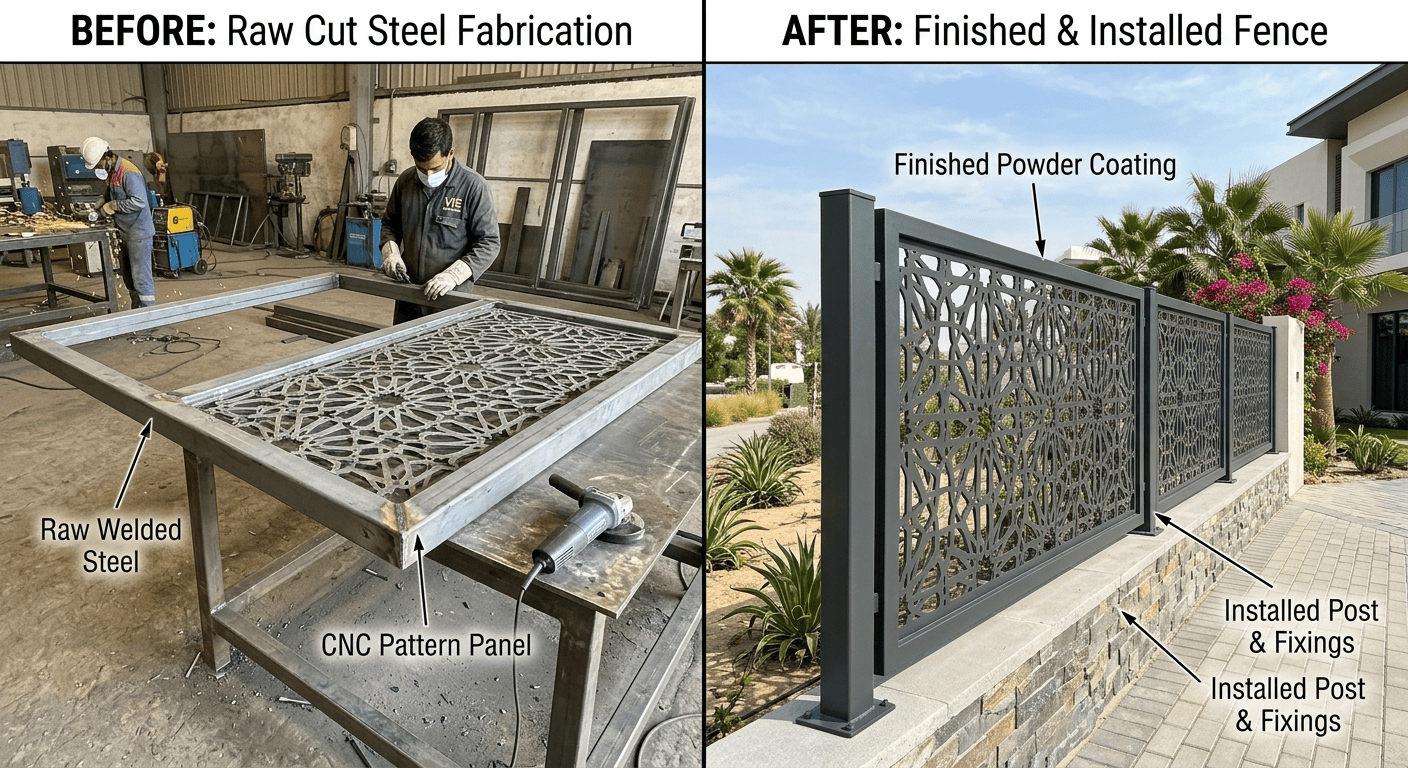
A trading company buys finished or semi-finished panels — often imported — and resells them with basic on-site assembly. A fabricator designs, cuts, forms, welds, and finishes the fence in-house from raw steel or aluminum stock, to the exact dimensions a site requires.
The difference shows up in three places:
Customization. A fabricator can match an irregular boundary, a sloped site, or a nonstandard gate width. They do not need to wait for a new shipment of imported panels made for someone else’s project.
Lead time on non-standard orders. Cutting and forming locally is faster than reordering custom sizes from overseas once a project is already underway.
Accountability for defects. If a weld fails or a coating peels, a fabricator that built the fence can trace the fault to a specific process step — cutting, welding, or galvanizing — and correct it directly. A trading company has to escalate back to its own supplier, often outside UAE jurisdiction.
Vision Industries fabricates fencing and gate structures in-house at our Sharjah facility: CNC cutting and forming, welding and assembly, and finishing all happen on one site rather than across multiple outsourced vendors.
| Fence Type | Material | Typical Use | Key Advantage |
|---|---|---|---|
| Palisade fencing | Galvanized or powder-coated mild steel | Industrial perimeters, utility sites, warehouses | High security; difficult to climb or cut |
| Chain-link fencing | Galvanized steel wire (GI) | Construction sites, sports courts, temporary boundaries | Low cost, fast to install |
| Welded mesh / anti-climb fencing | Galvanized steel, small-aperture mesh | Airports, substations, government facilities | Resists climbing and cutting attempts |
| PPGI corrugated fencing | Pre-painted galvanized steel sheet | Construction hoarding, temporary site boundaries | Solid visual screening, reusable |
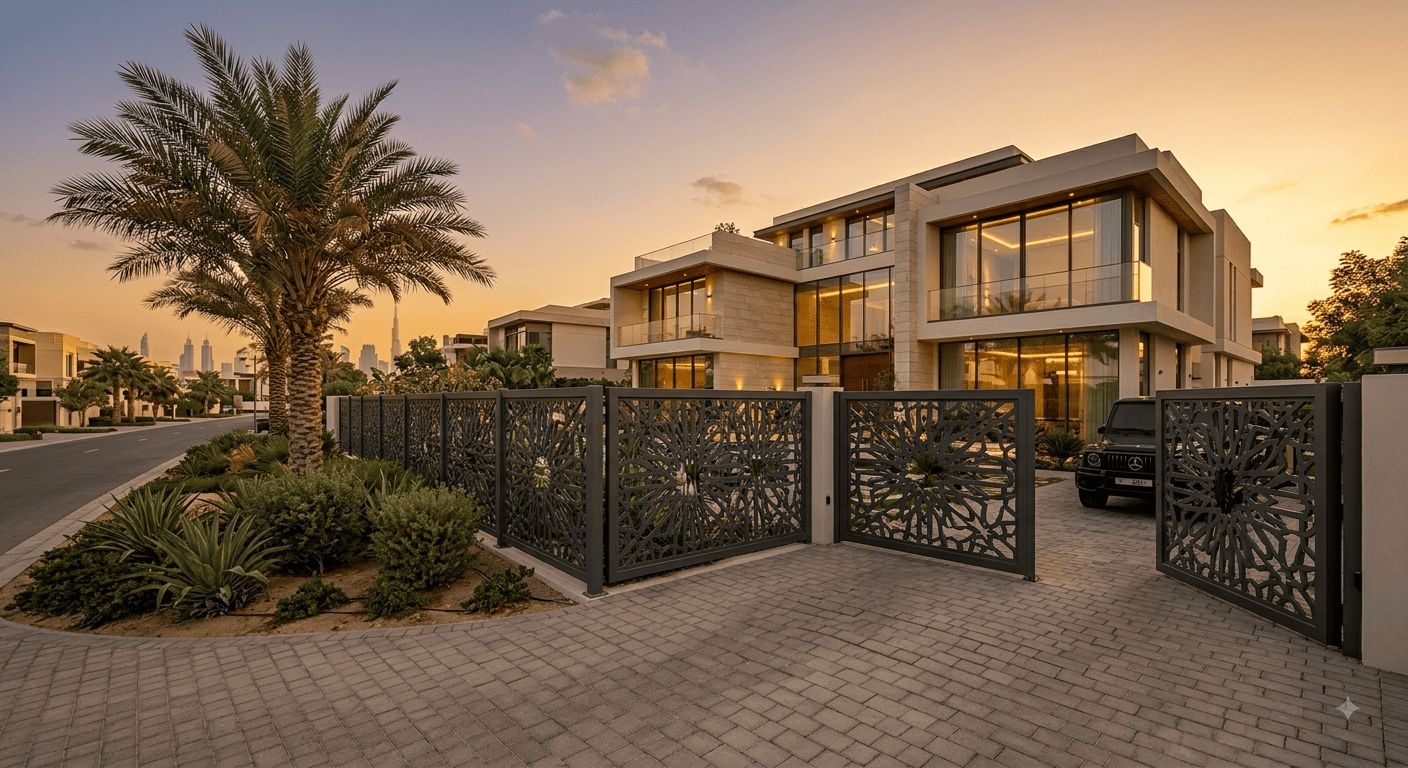
| Wrought iron / decorative steel fencing | Mild steel, powder-coated | Villas, community entrances, heritage-style projects | Ornamental, fully customizable design |
| Cast or decorative aluminum fencing | Cast or extruded aluminum | Mosques, municipal projects, upscale villas | Corrosion-proof, low maintenance |
| Powder-coated aluminum picket fencing | Extruded aluminum | Pool areas, villa gardens, balconies | Lightweight, rust-proof, wide color range |
| Glass-and-metal-frame fencing | Steel or aluminum frame, tempered glass | Pool safety barriers, modern villa boundaries | Unobstructed view, contemporary look |
| Laser-cut / perforated fencing | 2–4mm steel or aluminum sheet, CNC laser-cut | Privacy screens, Mashrabiya-style facades, feature walls | Combines security with custom pattern design |
Height, Safety & Wind Load Benchmarks
Exact requirements vary by emirate, community, and project type, but the following are common industry benchmarks worth planning around before a design is finalized:
- Villa boundary fences: typically 1.8m to 2.4m, depending on plot type and community guidelines
- Swimming pool fences: commonly a 1.2m minimum, self-closing and self-latching, opening outward, with no gap wide enough for a 100mm sphere to pass through
- Balcony and parapet fences: typically a 1.1m minimum from finished floor level, with vertical infill spacing under 100mm
- Commercial security fences: typically 2.4m to 3.0m, often topped with anti-climb detailing
- Anti-climb mesh: apertures under 50mm x 50mm where public access sits adjacent to the fence line
Confirm the exact figure for your specific plot or facility with your community’s owners’ association or the relevant municipality — these are planning benchmarks, not a substitute for project-specific approval.
Wind load is the other variable that catches people off guard. A solid fence panel acts like a sail. More surface area means more sideways force. It transfers that force to posts and footings during a shamal wind event. Perforated or mesh designs cut that load substantially — a panel with roughly 40% open area experiences meaningfully less wind pressure than an equivalent solid one — which is one reason palisade and mesh fencing dominate exposed commercial sites while solid decorative panels need a proper structural check before installation. Post spacing generally runs 2.0m to 2.5m for residential fencing and tightens to 1.5m to 2.0m for commercial high-security runs, with embedment depth scaling to fence height and local soil conditions.
Materials, Coatings & Technical Specifications
| Specification | Typical Range / Standard | Why It Matters in the UAE |
|---|---|---|
| Steel type | Mild steel (MS), galvanized iron (GI) | MS is the base material for most fabricated fencing; GI adds base corrosion resistance |
| Sheet/panel gauge | Roughly 0.4mm–0.9mm for profiled sheet; heavier gauge for structural posts and palisade pales | Thinner gauges suit temporary/site fencing; thicker gauges suit permanent perimeter fencing |
| Hot-dip galvanizing | Tested to BS EN ISO 1461 (or the North American equivalent, ASTM A123) | Coating thickness is proportional to steel thickness — the standard sets the minimum, which directly determines corrosion life |
| Powder coating | Polyester-based, UV-stable, RAL color range, to AAMA 2604/2605 or Qualicoat Class 1 | UAE’s UV exposure degrades non-UV-stable coatings within 1–2 years; specify UV-stable polyester specifically |
| Ornamental aluminum systems | ASTM F2957 — structural load and picket testing, coating adhesion and salt-fog testing | Confirms an aluminum fence system can carry real loads, not just look the part |
| Chain-link framework | ASTM F1043 — strength and protective coating on steel fence framework | Sets the minimum coating and strength baseline for chain-link posts and rails |
| Post spacing & footing | Site-specific — see wind load benchmarks above | Solid panels catch more wind load than mesh or louvered designs, so they typically need closer post spacing and deeper footings |
Two things worth flagging to anyone specifying UAE fencing:
Solid panels are not automatically the strongest choice, for the wind-load reason covered above.
“Galvanized” and “powder-coated” are not competing options — they’re usually combined. Hot-dip galvanizing protects the base steel from corrosion; powder coating on top adds UV-stable color and a second physical barrier. A fence that’s only powder-coated over bare or lightly treated steel will corrode from any scratch or weld point first.
For ornamental aluminum, ASTM F2957 is the key standard to ask a supplier about.
It is the only fence standard written for aluminum systems, not steel.
It covers structural testing and coating performance under corrosion and weathering.

Residential Metal Fencing: What Homeowners Should Know
For a villa or private property, a fence has to do four things at once: define the boundary, provide privacy, hold up to the climate, and look intentional rather than industrial. Powder-coated mild steel and aluminum dominate this segment because both take color well and resist the corrosion that plain steel suffers within a season near the coast. Laser-cut aluminum privacy panels — Mashrabiya-inspired or purely geometric — are increasingly common on new villa boundaries for exactly this reason: full privacy control without the solid, closed-off look of a block wall.
If the fence borders a pool, use the pool-fence benchmarks above as your starting point, and confirm the exact requirement for your community with your developer’s owners’ association, since it varies by community manual, not just by emirate.
Commercial & Industrial Fencing: What Contractors and Procurement Teams Should Know
For warehouses, factories, and active construction sites, the priority order flips: compliance and durability first, appearance second. Procurement teams typically need to specify, in the tender itself:
Steel grade and coating type (GI vs. PPGI vs. powder-coated over galvanized base)
Minimum coating thickness and the standard it’s tested against
Post spacing and footing depth appropriate to the site’s wind exposure
Lead time for the full order quantity, not just a sample panel
Whether the fabricator can supply material test certificates for the batch used
Beyond straightforward perimeter security, some commercial sites — multi-story car parks in particular — combine fencing with functional sun-shading, using perforated aluminum louvers that block direct UV and reduce cooling load on the structure behind them while still serving as the security boundary.
A fabricator that also handles turnkey installation removes one layer of contractor coordination from the project, since design, production, and site mobilization sit with a single accountable party.
How a Metal Fence Is Fabricated: From Drawing to Installation
Site survey and measurement — actual boundary lengths, gate openings, ground level changes, and existing structures are measured on site, not estimated from a plot drawing alone.
Design and drawings — the fence is drawn to the site’s real dimensions, including any custom panel, gate, or bracket details.
Cutting and forming — steel or aluminum stock is cut and formed to those drawings using CNC and press-brake equipment, which is what allows non-standard sizes without custom tooling costs.
Welding and assembly — panels, posts, and gates are welded and assembled to the design tolerances.
Surface treatment — hot-dip galvanizing, powder coating, or both, depending on the specification.
Quality check — weld integrity, coating coverage, and dimensional accuracy are checked against the drawing before dispatch.
Delivery and site installation — posts are set to the required footing depth and panels are fitted and aligned on site.
What Affects the Cost of a Metal Fence in the UAE
Fence pricing shifts enough by project that a single blanket rate is more misleading than useful — but the relative cost position of each option is consistent across UAE suppliers:
| Fence Type | Relative Material Cost | Relative Installed Cost |
|---|---|---|
| Chain-link (galvanized) | Low | Low |
| Welded mesh / anti-climb | Low–Medium | Medium |
| Palisade | Medium | Medium |
| PPGI corrugated hoarding | Low | Low–Medium |
| Powder-coated aluminum picket | Medium | Medium–High |
| Wrought iron / decorative steel | Medium–High | High |
| Cast or decorative aluminum | High | High |
| Stainless steel 316 | Very High | Very High |
As a concrete anchor point: commercial galvanized chain-link fencing, one of the least expensive options on this list, typically runs AED 25 to 90 per meter installed in the current UAE market, depending on coating type, height, and project size. Every other fence type on the table scales up from there based on the same variables:
Material — aluminum and cast decorative work generally cost more per meter than mild steel; galvanized-only costs less than galvanized-plus-powder-coated
Height and total run length — cost scales with both, but per-meter cost usually drops on longer continuous runs
Design complexity — decorative or cast detailing, and laser-cut pattern density, cost more than standard palisade or mesh panels
Coating specification — UV-stable powder coating over hot-dip galvanizing costs more upfront than galvanizing alone, but extends the repaint cycle significantly
Site conditions — difficult ground, restricted site access, or work in occupied/live sites all affect installation cost independent of the fence itself
Permit and consultancy fees — factor these in separately from the fabrication quote itself
Because these variables shift per project, request a site-specific quotation rather than relying on a generic per-meter rate found online.
UAE Fence Regulations, Setbacks & Permits You Need to Know
Permits. Most boundary wall and fence work on a villa or commercial plot requires municipal approval — typically a Minor Works permit for straightforward boundary fencing, or a Major Works permit if the fence is part of a larger structural change. Requirements and current fees are set by each emirate’s municipality (Dubai Municipality, Sharjah Municipality, or Trakhees/DDA in specific freehold zones) and are revised periodically, so confirm current requirements directly before starting work.
Setbacks. The minimum distance a boundary fence or wall must sit from the property line, road, or a neighboring plot is defined in your title deed and community manual, not by a single UAE-wide number. Always check the plot-specific setback before finalizing a fence design.
Industrial buffer zones. UAE land-use regulation requires a landscaped buffer — including a fence or living green boundary — between industrial zones and adjacent residential or commercial zones, with minimum widths set out in the relevant local land-use order. This is directly relevant to any factory, warehouse, or industrial-plot procurement team specifying perimeter fencing.
Licensed contractor requirement. Permit applications generally need to be submitted by a DED-registered, municipality-approved contractor or consultancy — worth confirming your fabricator or installer holds this before signing a contract.
Fence Fabricator vs. Fence Trading Company: How to Choose
| Question to Ask | Fabricator (in-house production) | Trading Company (resells imported stock) |
|---|---|---|
| Can you produce a non-standard size without a new import order? | Yes — cut and formed to order | Usually limited to stock sizes |
| Can I visit the factory floor? | Yes, typically | Often no factory to visit |
| Who’s accountable if a weld or coating fails? | The fabricator directly | The original overseas supplier |
| Typical lead time for custom orders | Shorter — production is local | Longer — depends on shipping and reordering |
| Can they supply CNC/press-brake technical drawings for a tender? | Yes | Rarely |
For a procurement manager running a tender, asking these five questions in the RFQ stage filters out resellers before pricing is even compared.
Fence Lifespan & Maintenance by Material
| Material / Finish | Typical Lifespan (UAE conditions) | Maintenance Needed |
|---|---|---|
| Hot-dip galvanized steel (uncoated) | 15–25+ years | Minimal; inspect for coating damage at cut edges/welds |
| Galvanized + powder-coated steel | 15–20+ years | Occasional wash; touch-up if coating is chipped |
| PPGI sheet (temporary/site fencing) | 3–7 years | Low; designed for shorter-term use |
| Powder-coated aluminum | 20–25+ years | Very low; aluminum doesn’t rust |
| Cast aluminum (decorative) | 25+ years | Very low |
| Untreated / painted-only mild steel | 2–5 years | High; repaint regularly to prevent rust |
The pattern across every material: the coating and its standard of application — not the base metal alone — determines how long a fence actually lasts in UAE conditions. A quick seasonal habit that extends any of the above: rinse the fence with fresh water every few months to clear salt and sand buildup before it works into a coating edge or weld point.
Frequently Asked Questions
Q : Do I need a permit to build a boundary fence in the UAE?
Answer : In most cases, yes. Boundary fences and walls typically require municipal approval — a Minor Works permit for standard fencing, or a Major Works permit for larger structural changes. Requirements vary by emirate and by community, so confirm with your local municipality before starting.
Q : What’s the difference between GI and PPGI fencing?
Answer : GI (galvanized iron) is steel coated only in zinc for corrosion resistance. PPGI (pre-painted galvanized iron) is galvanized steel that also has a factory-applied paint finish on top, giving it color and an additional protective layer.
Q : How long does a hot-dip galvanized fence last in UAE weather? Answer : Properly hot-dip galvanized steel, tested to BS EN ISO 1461 or ASTM A123, typically lasts 15–25+ years in the UAE with minimal maintenance, since the zinc coating thickness is directly proportional to the steel’s expected corrosion protection period.
Q : Can a fence be custom fabricated to an irregular plot shape?
Answer : Yes. A fabricator working from CNC and press-brake production can cut and form panels to match an irregular boundary, sloped ground, or a non-standard gate width — something a trading company limited to stock panel sizes usually cannot do without a special import order.
Q : Is chain-link or palisade fencing better for security?
Answer : Palisade fencing generally offers higher security, since its solid, pointed steel pales are harder to climb or cut through than chain-link mesh. Chain-link is better suited to lower-security or temporary applications like construction site boundaries.
Q : What is ASTM F2957, and why does it matter for aluminum fencing?
Answer: It’s the specification written specifically for ornamental aluminum fence systems, covering structural load testing, picket testing, and coating performance under corrosion and weathering. Asking a supplier whether their aluminum fencing is tested to F2957 is a fast way to separate an engineered system from a decorative import.
Q: Do you supply and install, or fabricate only?
Answer: Vision Industries fabricates fencing in-house — cutting, forming, welding, and finishing — and also handles turnkey site installation, so the same team is accountable from design through to the finished, installed fence.
Q : What’s the typical lead time for custom fence fabrication?
Answer : Lead time depends on total quantity, coating specification, and design complexity. Standard palisade or mesh fencing is generally faster to produce than decorative cast or highly custom designs — request a project-specific timeline at quotation stage.
If a fence is already galvanized, is powder coating still necessary? Not structurally, but it’s recommended where appearance matters or where an exact color is required. Galvanizing alone provides corrosion protection; powder coating adds UV-stable color and a secondary protective layer on top of it.
Fencing a Villa, a Site, or a Facility?
Vision Industries fabricates and installs metal fencing across the UAE from our Sharjah facility — from decorative villa boundaries and laser-cut privacy screens to industrial palisade and mesh security fencing. The same team handles design, CNC cutting, welding, coating, and installation, so accountability never splits across separate vendors.
If you’re comparing a gate alongside your fence project, our guide on custom gates and railings covers material and design choices for the entrance itself. And if you’re not sure what details to send over first, our project brief checklist walks through exactly what a fabricator needs to quote accurately.
Explore our precision metal manufacturing services, our site installation services, or get in touch with your project specifications for a quotation.
about
Vision Industries LLC
Engineering precision metal fabrication and Architectural structural solutions for commercial and residential projects across the region.




